Professor Helen E. Bryant — DNA replication & repair
DNA Replication & Repair Group
University of SheffieldWelcome to our lab
From replication stress to targeted cancer therapy
We decode how cells respond to replication perturbation, translate that knowledge into predictive biomarkers and exploit vulnerabilities for therapeutic benefit — including targeted inhibitors and photo‑activated agents.
Principal Investigator
Professor Helen E. Bryant
Professor of Cancer Therapeutics
Professor Bryant is an internationally recognised genome biologist whose work contributed to the preclinical foundation for PARP‑inhibitor therapy and continues to translate DNA repair biology into new therapeutic strategies.
Full profile →Programmes
Four research programmes
01
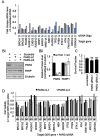
Replication stress and fork stability
How do cells protect and restart stalled replication forks, and which vulnerabilities in tumour cells can be exploited therapeutically?
02
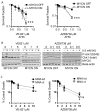
PARP and PARG biology in synthetic lethality
How can defects in homologous recombination and related DNA-damage responses be exploited with PARP- and PARG-directed therapies?
03
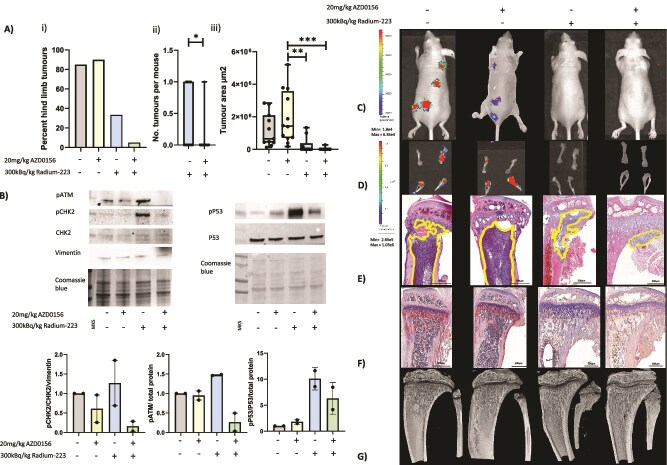
Checkpoint modulation and radiosensitisation
Can checkpoint and DNA-damage-response inhibitors improve tumour control with radiotherapy and radiopharmaceutical treatments?
04
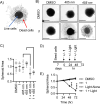
Photoactivated therapeutics and chemical biology
Can visible-light-activated metal complexes deliver spatially controlled cancer-cell killing with limited dark toxicity?
Selected publications
Recent and defining work
2005↗2005↗2009↗2017↗2020↗
Specific killing of BRCA2-deficient tumours with inhibitors of poly(ADP-ribose) polymerase
Nature
Poly(ADP-ribose) polymerase (PARP-1) in homologous recombination and as a target for cancer therapy
Cell Cycle
PARP is activated at stalled forks to mediate Mre11-dependent replication restart and recombination
The EMBO Journal
Specific killing of DNA damage-response deficient cells with inhibitors of poly(ADP-ribose) glycohydrolase
DNA Repair
Poly(ADP-Ribose) Glycohydrolase (PARG) vs. Poly(ADP-Ribose) Polymerase (PARP): function in genome maintenance and relevance of inhibitors for anti-cancer therapy
Frontiers in Molecular Biosciences
Join the group